Description
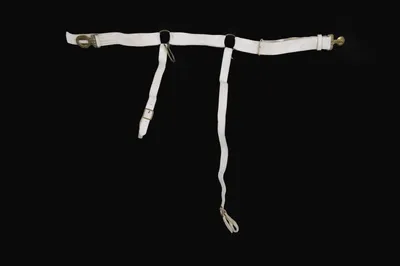
Officer's undress black patent leather sabretache with black morocco leather foul-weather cover. The front flap is made of a stiff highly polished black patent leather applied to both sides of the flap. The flap measures 12 inches in length and 10 1/2 inches in width and is sewn along the top edge to a back flap made of a softer black patent leather. A black patent leather gussetted pouch with flap is sewn into the back flap.The pouch and flap are lined with a cream plain weave cotton fabric glued to the inside. A patent leather strip has been sewn across the lower third of the outside back flap dividing the strap into three. This is designed to take the free end of the straight-ended billet after it is secured over a brass stud on the back flap. The pouch itself has a short square-ended billet which secures over a brass stud. Three brass D-loops are sewn under leather tabs along the top edge of the sabretache for attachment to the waist belt using slings. Attached to the centre front of the front flap is a finely cast gilded brass badge of the British coat of arms. The word 'VICTORIA' lies beneath this and surmounts an 1854 pattern field gun over the motto 'AUT PACE AUT BELLO' (In Peace and in War). arms. The foul-weather cover is made of a black morocco leather which has a fine horizontal lined pattern calendared into it. The inside sufaces of the cover are lined with a deep plum-coloured velveteen. The front of the cover is cut away to display the front of the sabretache when it is inserted inside the cover. Two short leather straps with brass studs and corresponding holes along the top edge secure the cover around the sabretache.
Contextual Description
Sabretaches for carrying documents were introduced into the British Army between 1806 and 1808. They were first used by Hungarian light horse in the 1700s. It is belived that this undress sabretache was used by officers of the various Victorian artillery units with gilt metal or white patent leather slings for both full dress and undress occasions until the more ornate full dress sabretache was adopted. Examples of the same pattern of sabretache can be seen in photographs of artillery unit officers of the day. As the motto used is 'Aut Pace Aut Bello' it would be expected that the sabretache was manufactured before 1893 when the Victorian Military Forces adopted the motto 'Pro Deo et Patria' (For God and Country). However uniform and equipment previously issued but still in good order often continued to be used well after a new pattern was introduced. It is also possible that the motto for some items of unfirom and equipment were also retained along with the new motto. It is interesting to note that the pattern of gun depicted on the badge is that of a 9 pounder field gun used at the Battle of Waterloo. This badge was introduced into the Royal Artillery in 1855. In 1871 the badge pattern was changed and modelled on the 9 pounder rifle muzzle loader field gun that was issued to the British Horse and Filed Artillery in that year. The rivets found on the metal carriage of the gun can be clearly seen in examples of the later pattern of Royal Artillery badge. The reasons for why this earlier pattern of badge were still in use for Victorian forces is not clear. The use of sabretaches was discontinued by the British Army and colonies in November 1901.
Details
Accession Number
REL/18068.005
Physical Description
Material: Brass
Material: Cotton
Material: Leather
Material: Patent leather
Material: Velveteen
Measurement
Overall: 360 mm x 310 mm x 20 mm
Copyright
Copyright not applicable
Conflicts
Places
Units
Tags