Description
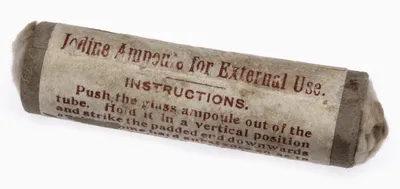
Small hand-blown teardrop shaped glass iodine ampule. The ampule is unbroken and still contains its original contents. The bulbed end is wrapped in a cotton gauze applicator and tied with cotton thread. Still stored in its original card tube, and held in place by a small wad of cotton at each end.
The tube bears the maker's name and the following instructions, printed in blue : 'Iodine Ampule for External Use Instructions for Use: Push the glass ampule out of the tube. Hold it in a vertical position and strike the padded end downwards against some hard substance so as to break the end of the glass bulb contained within the pad. The Iodione will at once saturate the pad by means of which it should be freely applied to the wound and surrounding skin before applying the First Field Dressing.'
Contextual Description
This iodine ampule was carried by 19623 Driver Arthur Gordon Pengilly during his service with the 8th Australian Field Ambulance, AIF. Pengilly, born at Parkside, South Australia was residing with his parents and aged 19 years 11 months when he enlisted on 17 September 1915. He was assigned to 29 Battery, 8th Field Artillery Brigade (8 FAB). After training in Australia (including at the AIF Signals School), Gunner Pengilly embarked for overseas service from Sydney on 20 May 1916 aboard the transport 'Medic'. He joined his unit in France on 30 October. From 6 – 21 May 1917, Pengilly was transferred to the 3rd Division Ammunition Column, before rejoining his unit. He was promoted to Extra Regimental sergeant on 21 December 1918, during his return voyage to Australia aboard the ‘Borda’. He was discharged on 4 April 1920.
Details
Accession Number
REL/05919
Physical Description
Material: Cardboard
Material: Cotton wadding
Material: Glass
Material: Medicine
Measurement
Overall: 22 mm x 64 mm x 17 mm
Gallery location
Main Bld: First World War Gallery, Western Front 1917
Copyright
Copyright not applicable
Conflicts
Units
Tags