Description
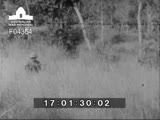
The Australian forces were put through a day of training on the rapel tower on October 24 1972 in preparation for the PIQ (Periodic Individual Qualification) testing the next day. The men fasten a rope about themselves (Swiss Seat) to which a snap link is attached. The double rope attached to the tower is run through this snap link and is arranged around the man's body so that he is able to control his rate of descent. As a training precaution a man is stationed at the bottom who is able to also control the man's descent should he get in trouble. The face of the tower represents a cliff for mountain instruction. On the sides of the tower is a simulated helicopter rapelling exercise. The log representing the skid of the helicopter from which they make the initial jump. The other portion of the confidence building course is the Slide for Life cable strung from bank to bank over a small lake at Schofield Barracks. A pulley block with handles is placed on the cable, and from this the men dangle as they reach speeds of 35-40 mph in their descent to the opposite shore. On the command "Raise Your Feet", the men attempt to raise their feet on a parallel to the water's surface which theoretically provides a skiing surface to break and slow the men's fall. The instructor with the flags attempts to time his commands so that the men have a minimum distance swim to shore, but definitely not too minimum. The three rope bridge is yet another portion of the confidence course because of the difficulty of crossing it, besides it is a practical method of getting the men back across the lake. This bridge can be hastily erected to cross water obstacles in combat zones. On 25 October the men received the PIQ tesing consisting of the helicopter rapel and a longer and faster Slide for Life. In the helicopter rapel 4 men are lifted to approximately 60' above the ground. Two men jump simultaneously, one on each side, rapel to the ground and then take the position of safety man for the next man that comes down their rope. Each man performed the exercise once and then took off on a 7 mile road march that ended with a walk across the lake before beginning the wet slide for life exercise. This cable for the test was over twice as long and twice as high as the one that the men were on the day before. The Slide for Life has a limited tactical usage but is excellent as a confidence builder in overcoming fears of height and of water, as well as giving a man a general pride in his physical ability. Also identified: Private (Pte) James; Lieutenant W. J. Arndt of Brisbane, Qld; Corporal W. O. Perry of Toowoomba, Qld; Pte R. D. Hall of Adelaide, SA; Pte M. J. McKay of Adelaide, SA; Lance Corporal P. J. Mowles of Brisbane, Qld.
Details
Cinematographer
Sergeant C A Murphy
Object Type
Actuality footage
Physical Description
Base: acetate
Colour: Colour
Film type: ORP
Format: 16mm
Sound: silent
Measurement
Duration
Footage
Projection speed
Conflicts
Units
Tags