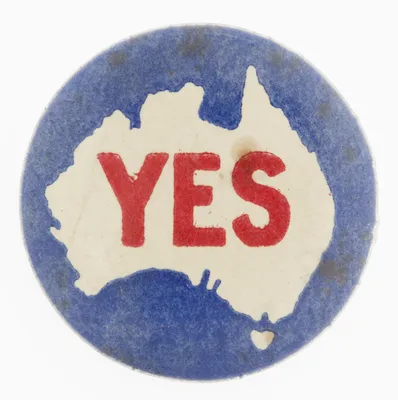
Description
Small circular pressed tinplate badge with a celluloid face and a pin attachment to the reverse. `VOTE NO' is printed in white on a red bar across the middle of the badge and there is a red border around the edge of the badge. Curved across the top is `FIGHT AS FREEMEN' and across the bottom is `NOT AS CONSCRIPTS' in dark blue lettering.
Contextual Description
Australian voters were asked in October 1916, and again in December 1917, to vote on the issue of conscription. Universal military training for Australian men aged 18 to 60 had been compulsory since 1911. The referendums, if carried, would have extended this requirement to service overseas.
At the outbreak of the war, the number of people volunteering to enlist for the Australian Imperial Force (AIF) was so high that recruitment officers were turning people away. However, as the war went on, casualty rates increased and the number of volunteers declined, so that by 1916 the AIF faced a shortage of men. Despite opposition from his own party, Labor Prime Minister Billy Hughes decided to take the issue to the people in a referendum. The nation was asked to grant the government the power to compel citizens to serve overseas during the current war. The referendum provoked furious debate within the Australian community. It was held on 28 October 1916, and the proposal for conscription was narrowly defeated.
Enlistment for the war continued to fall however, and in 1917 Hughes called for another referendum on the conscription issue. This conscription campaign was just as heated as the first. On 20 December 1917 the nation again voted 'No' to conscription, this time with a slightly larger majority. Australia and South Africa were the only participating countries not to introduce conscription during the First World War. The conscription referenda were divisive politically, socially and within religious circles. Newspapers and magazines of the time demonstrate the concerns, arguments, and the passion of Australians in debating this issue.
Badges such as this were produced to encourage and display support of the anti-conscription campaigns, and were sold in trams, buses, at railways stations and at rallies.
Details
Accession Number
REL28376.005
Physical Description
Material: Celluloid
Material: Paper
Material: Tin
Measurement
Overall: 27 mm x 22 mm
Copyright
Copyright not applicable
Conflicts
Places
Tags